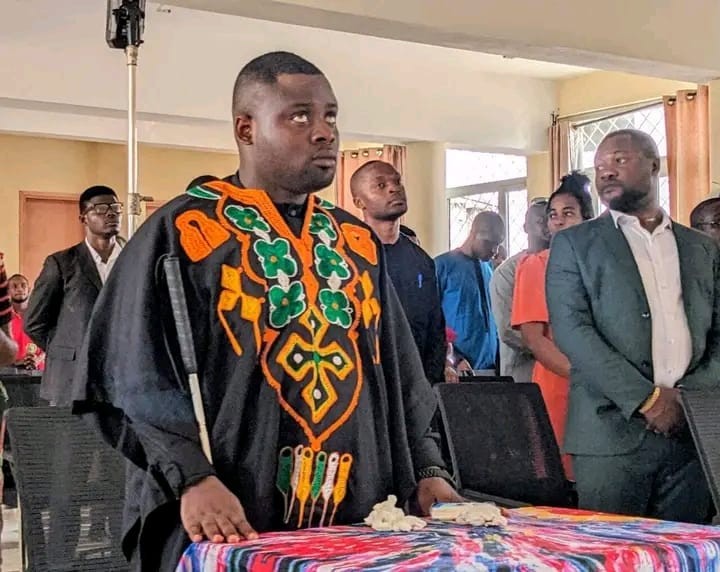
Dr. Prinsley Kesah facing the jury
By Guy-Bruno Maimo
A PhD study titled “Accessing Mass Media During Conflicts: Needs and Challenges of Persons with Visual Impairment in the Cameroon-Anglophone Conflict” conducted by Dr. Prinsley Kesah, Lecturer of International Relations and Conflict Resolution, has uncovered the significant barriers faced by persons with visual impairments (PVIs) in accessing essential media information during the ongoing Anglophone conflict in Cameroon. Dr. Kesah’s research reveals how this media gap leaves PVIs vulnerable, unable to respond to vital updates about the conflict, and putting their lives at risk.
Dr. Kesah’s study, which involved in-depth interviews with 20 PVIs and 11 media professionals in the North West and South West Regions, paints a stark picture of exclusion. According to Dr. Kesah, the lack of accessible media, especially in terms of radio, television, and social media has worsened the plight of visually impaired individuals during the crisis. “Without access to timely information about the conflict, PVIs are often trapped in dangerous situations,” he noted. “Many of them are killed or abducted simply because they couldn’t receive critical updates like curfews or safe zones.”
Dr. Kesah’s research focuses on the experiences of PVIs who have been left out of the media narrative during the Anglophone crisis. “In a conflict, information is literally a matter of life or death, and without access to it, PVIs are unable to navigate their surroundings and protect themselves,” he said. “This situation is even more critical when people with visual impairments have no way of knowing where to go or what’s happening around them.”
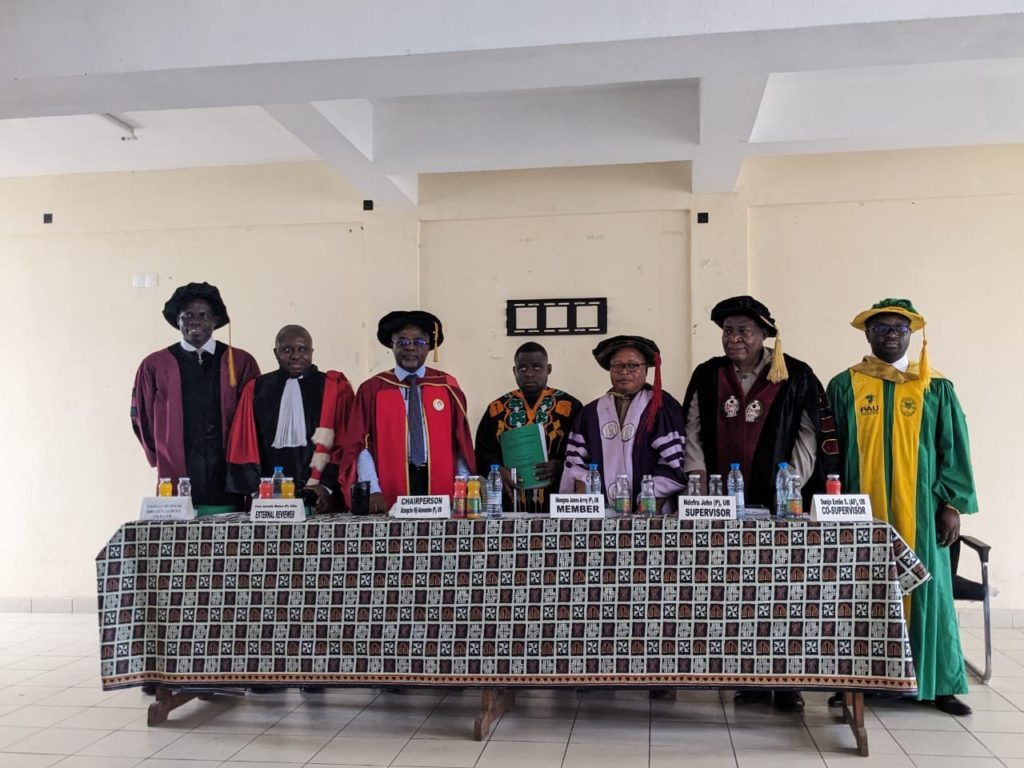
Dr. Kesah with examination panel after his PhD defense
While radio remains the most accessible form of media for PVIs, the study found that television and social media are often inaccessible due to their lack of accessibility features. Dr. Kesah emphasized, “There’s a huge gap in inclusive reporting. Many media outlets do not provide alternative texts for images or audio descriptions for videos, which leaves visually impaired persons in the dark.”
The study also highlights that PVIs often rely on assistive technologies, such as screen readers, to navigate digital platforms. However, these technologies are not always compatible with the latest media content. As Dr. Kesah pointed out, “The rapid digitalization of media, combined with limited digital literacy, creates further exclusion for PVIs. They are effectively locked out of crucial information streams.”
Dr. Kesah’s work has received acclaim from academic peers, including Professor Atancho Nji Akonombo, Dean of the Faculty of Laws and Political Science at the University of Buea, who praised the study for addressing a long-neglected issue in both media coverage and academic research. “This research fills a crucial gap by exploring the media’s role in ensuring accessibility for PVIs in conflict zones, promoting an inclusive society where everyone can access vital information,” he noted. Professor Sunjo Emile, Senior Lecturer and Associate Professor at the University of Buea, also highlighted the innovative nature of Dr. Kesah’s work. “By combining media studies, human rights, and conflict resolution, this research frames media accessibility for PVIs as a human rights issue, adding an important dimension to the discourse on inclusive media and conflict reporting,” he remarked.
Despite international and national laws like the UN Convention on the Rights of Persons with Disabilities (2006) and Cameroon’s 2010 Law on the Protection and Promotion of Persons with Disabilities, Dr. Kesah’s study reveals that these legal frameworks are poorly enforced. “The laws exist, but without proper enforcement, PVIs remain marginalized in media discussions,” Dr. Kesah stated, emphasizing the need for policy changes to ensure that media outlets, particularly in conflict zones, uphold inclusivity. “Laws alone are insufficient; media organizations must adopt practices that align with these legal requirements,” Dr. Kesah concluded.
The study emphasizes the role of assistive technologies in facilitating media access for PVIs, stressing the importance of teaching them how to use these tools. Dr. Kesah highlights that when PVIs can’t access information independently, they need assistive technologies to empower them. This supports the need for media outlets to adopt inclusive practices, ensuring PVIs have the tools and support required to navigate media, particularly in crisis situations. Dr. Kesah also extends his call to action to government bodies like the National Communication Council and civil society organizations, urging collaboration to provide PVIs with life-saving media access in conflict zones. He stresses that all stakeholders must ensure PVIs can access media that is both informative and crucial for survival. His research calls for inclusive media policies to ensure no one is left behind during crises, emphasizing that addressing these barriers now will create a more inclusive media landscape for all citizens, regardless of ability.