By Neba Jerome Ambe
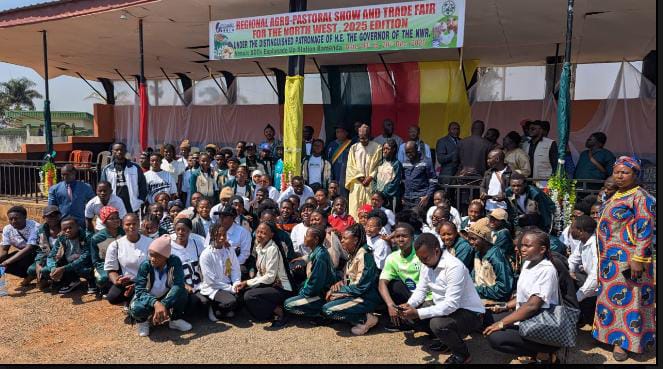
Against a backdrop of prolonged disruption and economic strain, the 2025 North-West Regional Agro-Pastoral Show and Trade Fair in Bamenda emerged less as a ceremonial gathering and more as a working blueprint for recovery. Rather than dwelling on past losses, the event placed solutions at the centre of the conversation: how to restore food production, strengthen farmer livelihoods, and reposition agriculture as the engine of regional stability.
Opening the show, Governor Adolphe Lele Lafrique framed agriculture not simply as a sector, but as the most practical response to the North-West’s current challenges. He described the fair as a problem-solving space where farmers, institutions, and development partners could align around concrete actions, boosting output, improving value chains, and ensuring food availability, particularly during peak demand periods such as the end-of-year festivities.
The Governor’s message resonated strongly with producers who travelled from across the Region, many navigating insecurity and difficult transport conditions to participate. Their presence, he noted, was itself evidence of a resilient production base that can be rebuilt if given the right support.

One of the key interventions highlighted was government-backed investment in agricultural infrastructure and import substitution. Through initiatives such as the Integrated Agro-Pastoral and Fisheries Import Substitution Plan (PIISAH), alongside renewed funding for UNVDA Ndop and MIDENO, authorities are seeking to reduce dependence on external food supplies while revitalising local production systems. The emphasis, Governor Lele stressed, must now shift to effective management and measurable output.
Development projects already on the ground are showing early results. Programmes like the Project to Unlock the Livestock and Crop Production Potential of the North-West and South-West Regions (PULCCA) and the Rice Value Chain Development Project (RVCDP) have helped farmers improve yields and livestock productivity. With PULCCA’s first phase drawing to a close in 2025, Regional authorities and partners are pushing for continuity to prevent communities from sliding back after initial gains.
Data shared during the event underscored this cautious optimism. The Regional Delegate of Agriculture for the North West, Ndueh Joh Ndimuangu, reported a 15 percent increase in agricultural production compared to the five-year average, a modest but significant indicator that recovery is possible even under constrained conditions.
Local authorities also see the agro-pastoral show as a market-linking tool. Bamenda City Mayor Paul Achombong noted that beyond exhibitions, the fair connects producers to buyers, processors, and investors, helping farmers move from subsistence to commercial viability.

Throughout the event, one condition was repeatedly underscored: peace and security. Governor Lele Lafrique made clear that sustained agricultural growth cannot occur without community cooperation and a stable environment, describing security as the soil in which all development efforts must take root.
As the show concluded, exhibitors and prize winners were encouraged not to view recognition as an endpoint, but as a responsibility, to scale up production, adopt better practices, and contribute to restoring the North-West’s reputation as a food-producing hub. In that sense, the 2025 Agro-Pastoral Show offered more than displays and speeches; it presented a roadmap for turning agriculture into a practical pathway from crisis to self-sufficiency.