By Nformi Ngi Jones Tamfu
The Atlantic coastline of Cameroon is undergoing a profound transformation in the sphere of regional commerce. Once characterized by serene, unassuming stretches of shoreline adjacent to the Kienke River, this area has emerged as the site of the Port of Kribi, a sophisticated deep-sea hub that is swiftly supplanting established competitors and positioning Cameroon for a robust industrial future.
Under the exceptional leadership of Patrice Melom, who serves as the General Manager of the Port Authority of Kribi, significant strides have been made in enhancing the understanding and accessibility of the maritime sector.
Through a series of strategic initiatives and outreach programs, the Port Authority has effectively demystified the complexities often associated with maritime operations and logistics. Melom’s vision has been instrumental in fostering greater transparency and clarity regarding port activities, thereby empowering stakeholders and the broader community to better comprehend the nuances of maritime affairs.

His commitment to education and communication has not only elevated the profile of the Port of Kribi but has also established it as a pivotal hub for international trade and maritime engagement in the region. For many years, Pointe-Noire in the Republic of Congo reigned supreme as Central Africa’s principal transit hub, a status it has now irrevocably lost.
Since initiating operations in 2018, the Port Authority of Kribi (PAK) has made remarkable strides, claiming a 23% market share and achieving recognition as the second-largest provider of customs revenue for the Cameroonian state. In the past year alone, the port contributed over 300 billion francs to the national treasury, a staggering increase when compared to the mere 1 billion francs collected before its inauguration.
The foundation of this unprecedented success rests in the port’s geographical and operational advantages. Unlike the Port of Douala, which struggles with significant tidal restrictions necessitating ongoing and costly dredging of its navigational channel, Kribi provides direct, uncontrolled access to the deep ocean. A representative from the port articulated this pivotal advantage: “We have a deep-water draft that allows us to accommodate the world’s largest vessels.” They further explained that where operators were previously compelled to utilize three separate ships to transport 60,000 tons of goods into Douala, they can now achieve this in a single voyage to Kribi. This efficiency dramatically reduces maritime freight costs, fundamentally altering the economic calculus for every enterprise operating within the region.

The enormity of the Kribi Industrial-Port Complex (CIPK) is compelling and multifaceted. For instance:
- The Quay: The current expansion of the quay extends by an impressive 715 meters, bringing the total length to 1,365 meters, with aspirations to reach nearly 7 kilometers in the nearest future.
- The Vessels: Notably, Kribi is the inaugural port in Central Africa equipped to accommodate “Mega-Ships,” vessels that measure 400 meters in length and are operated by leading shipping lines such as MSC, capable of transporting up to 24,000 containers.
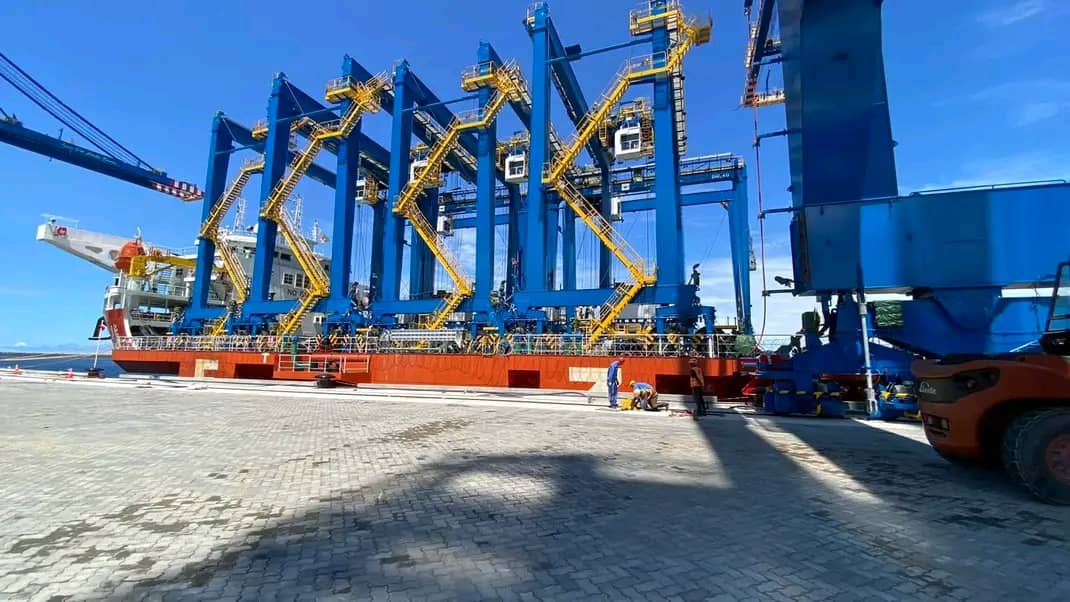
- The Arsenal: The terminal is currently supported by a robust fleet of seven Ship-to-Shore (STS) cranes and five Rubber-Tyred Gantry (RTG) cranes, with plans to expand this to a total of 15 RTGs by the close of 2024.
- Capacity: This state-of-the-art facility is strategically designed to manage an impressive throughput of 1 million Twenty-foot Equivalent Units (TEUs) on an annual basis.
The Kribi development initiative extends well beyond mere logistical operations; it embodies a strategic intent to cultivate an industrial metropolis. Spanning a vast expanse of 15,000 hectares, the port serves as the nucleus of an expansive industrial zone.
Presently, the hub houses a variety of industries including flour mills, cement production facilities most notably a Turkish-led plant with a remarkable capacity of 800,000 tons and it features the first assembly plant for construction equipment within the CEMAC region.
By the year 2027, projections indicate that overall investments are expected to exceed 500 billion CFA francs, with a noteworthy 46% of this influx stemming from local Cameroonian investors. This trend signifies a decisive move away from an over-reliance on external funding.
To further accelerate growth, Kribi has established a dedicated Business Creation Center, which allows aspiring entrepreneurs to register their companies on-site, vastly simplifying the bureaucratic process that previously required travel to regional capitals.
This significant growth trajectory has not been without its challenges. The port’s development has encroached upon ancestral lands traditionally occupied by fishing communities.
The management acknowledges the complexities involved in the relocation process, underscoring their dedication to acknowledging a shared history and fostering a sense of social responsibility.
Through initiatives such as PASEK, the port actively invests in refurbishing local clinics, distributing educational supplies, and prioritizing local employment opportunities evidently, a significant portion of the current terminal operations is managed by a predominantly Cameroonian workforce.
Looking ahead, the projections for infrastructural development are robust. With financial backing from the African Development Bank, National Road No. 7 (Edéa-Kribi) is slated for transformation into a high-standard highway.
Furthermore, the introduction of a new road linking directly to Campo will establish a direct connection to Equatorial Guinea, thereby reinforcing Kribi’s stature as the “Gateway to the Sub-Region.”
As the advanced high-speed scanners at the terminal gates continue to provide a “digital fingerprint” for every container entering the nation, it is evident that Kribi represents far more than an ambitious project in the making it is a tangible manifestation of Cameroon’s industrial renaissance and aspirational emergence on the global stage.