By Neba Jerome Ambe
Bamenda has taken a decisive step toward safer meat production and improved urban food systems with the formal handover of a newly constructed, ultra-modern slaughterhouse to the Bamenda City Council. The facility, built by the North West Development Authority (MIDENO) under the Livestock and Fisheries Development Project (LIFIDEP), was officially transferred to the council on Tuesday, 10 February 2026.
The project is part of a broader development partnership between the Government of Cameroon and the Islamic Development Bank, aimed at strengthening livestock and fisheries value chains while improving public health outcomes and livelihoods across the North West Region. A central objective of LIFIDEP has been the establishment of modern slaughter facilities capable of delivering fresh, hygienic and high-quality meat for urban and peri-urban populations.
Located at Manka’a–Mandah in the Bamenda III Subdivision, the slaughterhouse sits on a 1,752-square-metre site and has been designed to meet contemporary sanitary and operational standards. The main complex includes a lairage for holding animals before slaughter, water tanks and pumping systems, sanitary installations, a waste management unit, and a fully equipped slaughter hall. Dedicated slaughter lines ensure species-specific handling, with a separate line for sheep and goats to minimize cross-contamination and improve efficiency.
Complementing the main structure is a second building reserved for poultry processing. It houses clearly demarcated sections for slaughtering, bleeding, scalding, splitting and dressing, supported by overhead tanks that supply both hot and cold water. This layout is intended to enforce strict hygiene controls throughout the processing chain, from intake to dispatch.

Bamenda City Mayor & MIDENO GM exchanging documents of the handing over
Speaking at the handover ceremony, MIDENO’s General Manager, Cletus Anye Matoyah, underscored the importance of translating infrastructure investment into tangible public benefit as LIFIDEP enters its second phase. He noted that the decision to place the facility under the management of the City Council was deliberate, given its mandate to serve the wider urban population.
“As we transition to Phase II, it is essential that the infrastructure already delivered is effectively used,” he said. “This slaughterhouse is modern and strategically positioned. Under the City Council, it can serve not only Bamenda but also surrounding towns.”
Mr. Matoyah further reassured stakeholders that MIDENO’s role would not end with the transfer of ownership. Continuous technical and institutional support, he said, would be provided to ensure the facility operates sustainably and in line with health standards.
For the Bamenda City Council, the new abattoir represents a significant upgrade to municipal infrastructure and a practical response to long-standing public health concerns. City Mayor Achobong Tambeng Paul described the project as a milestone that would modernise meat processing and distribution in the city.
“This facility adds real value to the assets of the City Council,” the mayor said. “It will enable us to improve slaughtering practices and strengthen the entire meat distribution system.”
Highlighting the contrast with existing facilities, Mayor Achobong pointed to the introduction of mechanised processes and specialised equipment. Unlike the older slaughterhouse, the new complex includes skinning facilities and modern machines that largely replace manual operations, improving both efficiency and hygiene.
Looking ahead, the City Council plans to explore opportunities for meat packaging and distribution beyond Bamenda, with the potential to supply other towns. Such expansion, the mayor noted, could generate revenue needed to maintain and operate the facility sustainably.
One outstanding challenge identified during the handover is the lack of hygienic transport for moving meat from the slaughterhouse to markets. The City Council currently does not have a dedicated refrigerated meat van, a gap MIDENO considers critical to close.
“We are examining how to support the council with a meat van,” Mr. Matoyah said. “Our priority is to ensure that meat reaching consumers is healthy. Attention will also be given to improving access roads around both the old and new slaughterhouses.”
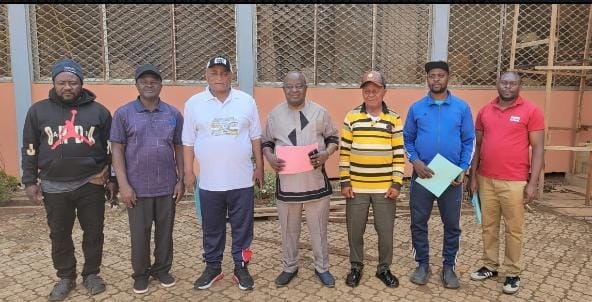
Group picture with those presents at the event
As part of the transition, staff of the Bamenda City Council will undergo technical training to operate and maintain the new equipment. With infrastructure, capacity building and institutional support aligned, the Bamenda slaughterhouse is expected to serve as a model for solution-oriented urban food systems, linking public investment to health, livelihoods and sustainable city management.