Group picture after installation with administrative authorities of the Region
By Neba Jerome Ambe
The Executive Council of the North West Regional Assembly was officially sworn into office on Wednesday, January 7, 2026, at the Bamenda Court of Appeal, in a ceremony that reaffirmed the government’s commitment to decentralisation and effective regional governance.
Presiding over the oath-taking exercise, judicial authorities formally installed the eight-member Executive Council charged with steering the political, administrative and developmental affairs of the North West Region in line with Cameroon’s decentralisation policy.
Heading the newly constituted council is Professor Fru Angwafo III, who was re-elected as President of the North West Regional Assembly. He will be assisted by Fon Nfor Amidu Nji, President of the North West House of Chiefs, who serves as Vice President of the Regional Executive Council, symbolising the institutional integration of traditional authorities into the decentralised governance structure.
Other members sworn in included Ghejung Awunti, re-elected as Commissioner for Economic Development; Professor Sakah Fondufe Lydia, Commissioner for Health and Social Development; Professor Anyambot Emmanuel Anya, Commissioner for Education, Sports and Cultural Development; Waindim Jude Nsom, Questor; Mvo Zenobia Ndum, Secretary I; and Fon Zofoa Abubaka Fuanfor Yung, Secretary II.
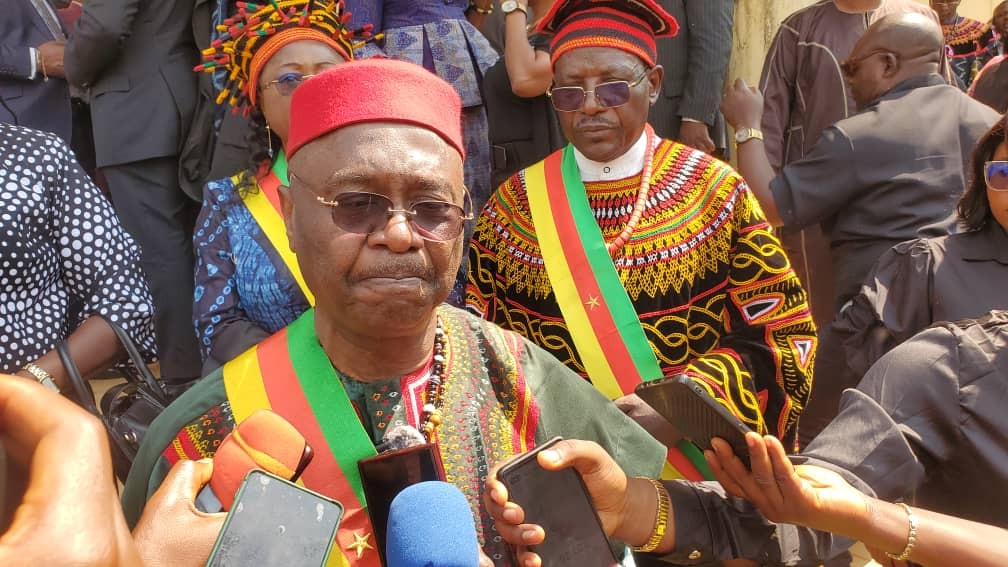
Professor Fru Angwafo talking to the press
The ceremony was attended by traditional rulers from across the Region, senior administrative officials, representatives of state institutions, members of civil society, and other invited dignitaries, reflecting the national importance attached to the functioning of regional institutions under the decentralisation framework.
One of the notable moments during the ceremony was the swearing-in of Fon Zofoa Abubaka Fuanfor Yung, the Fon of Babungo, who took his oath using a firearm. The act generated public discussion, particularly on social and traditional media platforms, concerning its cultural and legal implications.
Legal practitioners explain that within Anglo-Saxon legal tradition, which forms part of Cameroon’s judicial system, individuals taking oaths are permitted to swear by symbols that reflect their personal beliefs and cultural practices. While the Bible and the Quran remain the most commonly used, alternative symbols may be accepted, provided they convey a solemn commitment to truth and accountability.
In traditional contexts, the firearm is viewed not as an instrument of violence but as a symbol of authority, responsibility and personal honour. Swearing by such a symbol signifies a binding pledge to uphold the law and discharge duties with integrity. Legally, such an oath carries the same weight and consequences as those taken on religious texts.
Observers note that the episode highlights the coexistence of modern state institutions and traditional values within Cameroon’s decentralised governance system.
The oath-taking ceremony concluded with calls for collaboration, peace and development, as the new Executive Council assumes office at a time when the North West Region continues to face socio-economic and security challenges.