Dr. Ngong Peter Tonine in glasses
By Guy-Bruno Maimo
Dr. Ngong Peter Tonine’s successful defense of his PhD thesis has made history at the University of Buea, marking him as the first visually impaired PhD graduate from the Faculty of Social and Management Sciences. His achievement not only represents a personal milestone but also underscores the growing momentum for disability inclusion in higher education across Cameroon.
Dr. Ngong’s thesis, titled “University Social Responsibility Innovations within Host Communities in the North West and South West Regions of Cameroon,” examined how universities contribute to community development through initiatives like job creation, educational support for marginalised students, and infrastructure development. He found that while universities had made strides in these areas, more needed to be done to formalise partnerships with local communities and ensure that social responsibility efforts were sustainable and impactful. He equally emphasized the need for universities to engage more intentionally with their surrounding communities. “Universities should not just focus on teaching and research; they must actively contribute to the development of their host communities,” he said in an interview after the defense. “It’s about creating a relationship where both the university and the community benefit.”
Dr. Ngong’s achievement is particularly significant considering the many obstacles he faced throughout his academic journey. From the disruption caused by the Anglophone crisis to the loss of vital academic results, his persistence and resilience have become an inspiration for many, especially within the disability community, especially with those currently pursuing higher education. Njukang Princeley, a visually impaired master’s student in Journalism and Mass Communication at the University of Buea, reflected on how Dr. Ngong’s success will motivate him. “It tells me that I am standing on solid shoulders, on shoulders that will not let me down,” he said, stressing that “Seeing someone from my community excel at this level pushes me to aim even higher.
Dr. Kesah Princeley, a leading advocate for persons with disabilities and a colleague of Dr. Ngong, noted the historical significance of this achievement for the disability community. “Dr. Ngong is the first doctor with visual impairment produced by the University of Buea’s Faculty of Social Management Science. This is a huge milestone for disability inclusion, especially in the North-West and South-West Regions of Cameroon,” he remarked. He also stressed that Dr. Ngong’s success was a defining moment for people with disabilities. “We want to see how universities will now include us in their social responsibility initiatives. We are part of the community, and nothing for us without us.
Dr. Ngong’s success also stands as a testament to the inclusive education system at the University of Buea. Prof. Emmanuel Yenshu Vubo, Dr. Ngong’s supervisor and the Dean of the Faculty of Social and Management Sciences, expressed his pride in guiding Dr. Ngong through his academic journey. “This is not just a success for Dr. Ngong but for the university and the larger disability community. His achievement highlights our commitment to an inclusive education environment,” he stated.
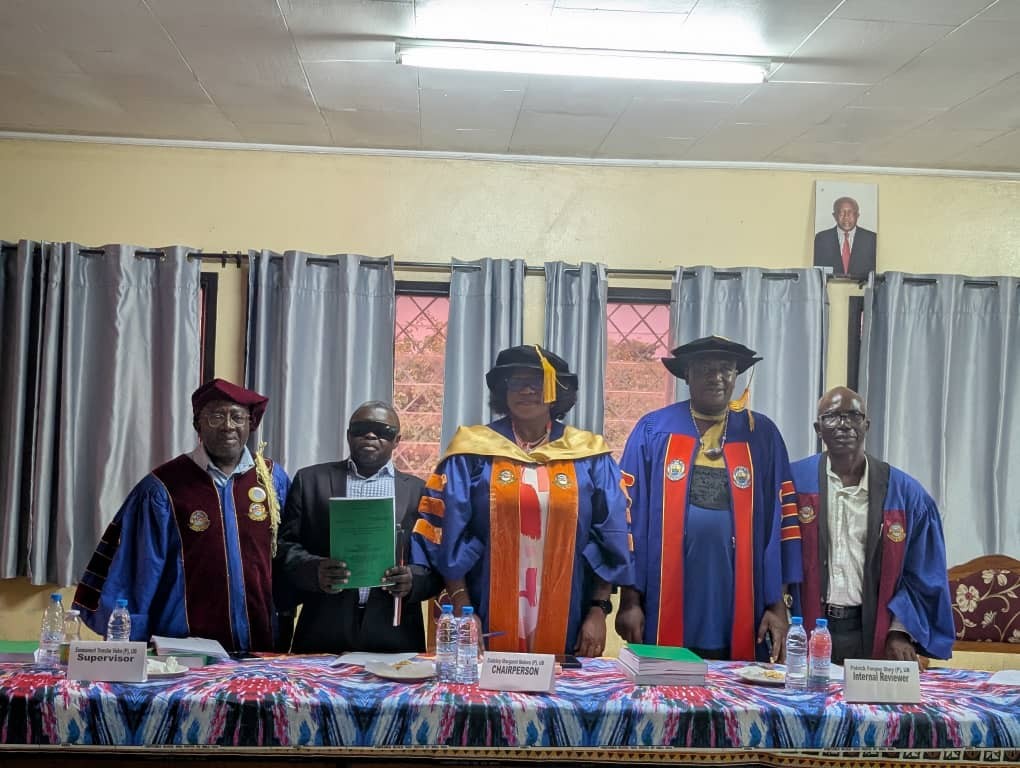
The defense, held on Friday, February 13, 2026, at the Faculty of Social and Management Sciences conference room, was chaired by Professor Margaret Nalova Endeley, a leading academic in Curriculum Studies and Teaching at the University of Buea. Prof. Endeley commended Dr. Ngong for his rigorous research and ability to articulate his thesis clearly.
Dr. Ngong’s research also brought attention to the growing importance of university social responsibility in the context of Cameroon’s higher education institutions. His findings suggest that while universities like the University of Buea have made important strides in offering services such as health care, water access, and agricultural support to their surrounding communities, these efforts need to be more formalized and structured for lasting impact. “The university must be an active participant in the well-being of its community, not just a place of knowledge,” Dr. Ngong emphasized. With his PhD now officially awarded, Dr. Ngong has set a powerful precedent for inclusive education at the University of Buea and beyond. His journey serves as a reminder that education, when made accessible, has the power to transform lives and societies.