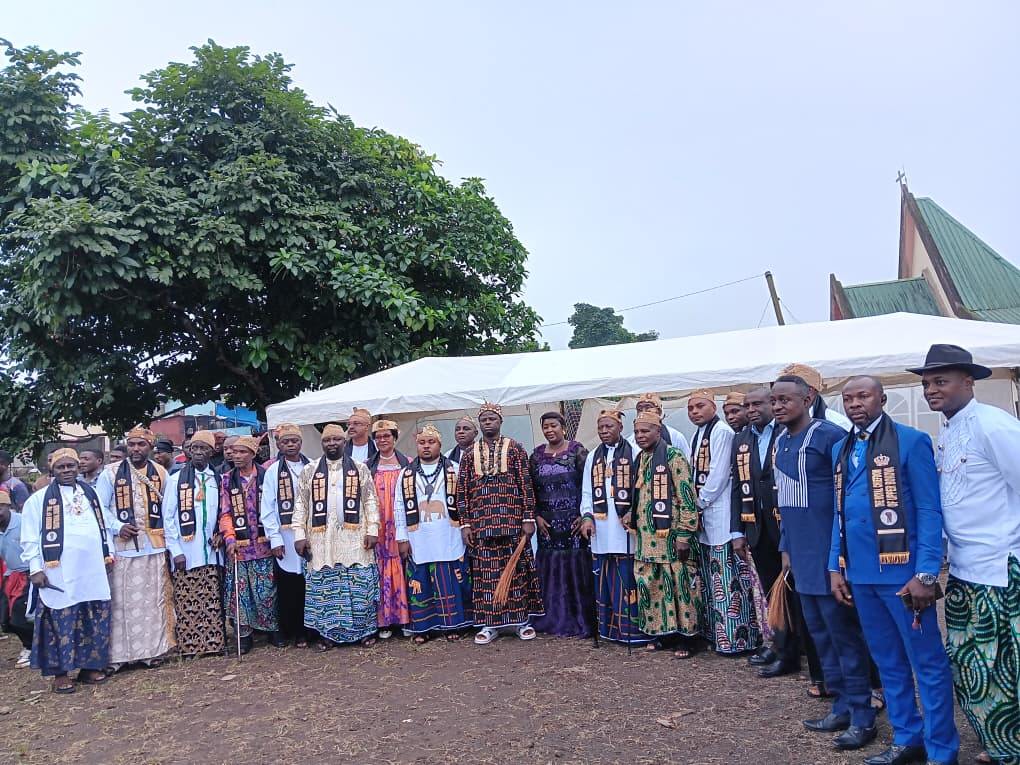
The Chief of Upper Bokova and DO’s representative with the newly installed Traditional Council
By Guy-Bruno Maimo
The Traditional Ruler of Upper Bokova in Buea Subdivision, HRM Chief Barrister Evanjoh Abel Nyoki (Mbella IV), has installed the chairman and members of the Upper Bokova Traditional Council, commissioned 11 functional committees and commissioned the village security and vigilante group in a move aimed at strengthening customary governance and advancing development in the community.
The installation ceremony took place on Saturday, July 25, 2026, at the Upper Bokova Community Field, bringing together administrative authorities, traditional rulers, clergy representatives, family representatives, quarter heads, elites and residents for the formal inauguration of the newly established structures.
The ceremony marked the completion of the Chief’s administrative structure following his coronation on April 25, 2026, with the newly established organs expected to support the realization of his vision of “Unity, Peace and Development” across the five quarters of Upper Bokova.
Speaking during the installation, Chief Nyoki described the Traditional Council as the bridge between the population and the chiefdom, charging its members to uphold justice, order and discipline while allowing the palace to concentrate on development initiatives.
“You are the bridge between the population and the chiefdom. If things are not going well, you are to be blamed. You are the ones to administer justice, order and respect in this community as it is not my job. Do that so that I focus on developmental issues,” the Chief said, urging the chairman to make effective use of council members. He also instructed him to keep a close watch on affairs across all five quarters, with the support of the Secretary General and Financial Secretary.
The Chief further emphasized that the committees created under the Traditional Council were established for concrete action and not merely for ceremonial purposes. “These committees are not for formality but for action. If you know you will not be equal to the task, come and see me for replacement,” he warned.
The 11 committees include Health, Hygiene and Sanitation; Lands and Village Roads; Education and Social Affairs; Water and Electricity; Farming and Marketing; Women Affairs; Youth Affairs; Discipline and Morality; Cultural and Sports; Financial Resources; and Community Project and Development.
The ceremony also featured the commissioning of the Upper Bokova village security and vigilante group, which the Chief said would contribute to improving security in the community. He noted that members would be equipped with basic security equipment, including torchlights, boots and raincoats, adding that the group is made up of individuals of tested and proven moral character
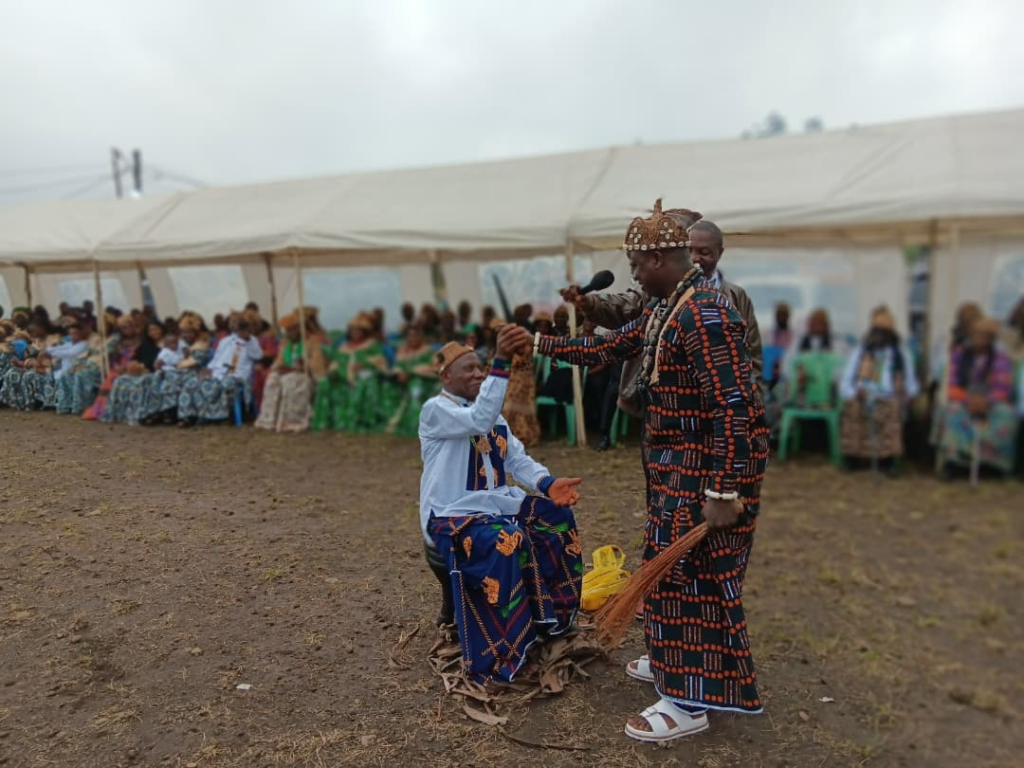
Chairman taking the symbol of power from the chief
Installed as Chairman of the Traditional Council was Sango Litute Walterson Maliva, alongside Sango Ndumbe Micheal Motimba as Secretary General, Nyango Bertha Joso Mbua as Assistant Secretary General, Sango Fred Lotongo Mokoko as Financial Secretary and Nyango Sarah Njonje Epse Baiye as Treasurer. The council is also composed of family representatives, quarter heads from the five quarters of Upper Bokova, clergy representatives and other appointed members.
In his acceptance speech, Chairman Maliva described the installation as the completion of the Chief’s leadership structure and pledged to work closely with the traditional ruler to achieve his vision for the village. “We have to work in close collaboration so that his vision and mission for this village will be seen from far and near,” he said, stating that his immediate task would be to engage quarter heads, establish coordination mechanisms and receive regular reports on developments across the community to ensure that the objectives of the Traditional Council are achieved.
Chairman Maliva also recalled that following Chief Nyoki’s coronation, royal decisions established the Traditional Council, appointed its leadership and created committees to operate at the quarter level. He noted that during the Chief’s visits to the five quarters, residents raised concerns including inadequate potable water, insecurity, rampant land sales and drug abuse among youth, challenges the new structures are expected to help address.
Speaking after the ceremony, Chief Nyoki said the installation of the Traditional Council, committees and vigilante group was designed to strengthen his administration and improve service to the population.
“I have charged the chairman with the authority to administer and advise the chiefdom on matters concerning the well-being of the village. I have equally charged him to ensure that the various committees are functional,” he said.
The traditional ruler encouraged the chairman to draw from the knowledge, experience and expertise of council members, stressing that collective action would be necessary to achieve lasting peace, unity and development in Upper Bokova.
Representing the Divisional Officer for Buea, Mme Juru congratulated Chief Nyoki for the reforms introduced since his enthronement and described the installation of the Traditional Council as a significant milestone in the life of the community.
She urged the newly installed council members to work in unity, support the Chief through constructive advice, respect the customs of the community and avoid divisions within the palace. “The traditional council is an advisory body and not a substitute for the authority of the chief,” she said, reminding members to remain supportive of the traditional ruler in the discharge of his responsibilities.
Attendees at the ceremony expressed optimism that the new governance structures would strengthen customary administration and contribute to the development of Upper Bokova.