By Guest Writer
More than 1,000 people reportedly descended on the Government Emergency Humanitarian Assistance Centre in Bamenda in the early hours of Friday, September 11, demanding assistance from the government.
The massive turnout at the centre was a vivid reminder that, despite years of humanitarian intervention, the needs of internally displaced persons (IDPs) and vulnerable populations in the crisis-hit North West remain enormous.
Men, women and other vulnerable persons converged on the facility seeking food and basic household necessities. Their presence highlighted the extent to which many families continue to depend on humanitarian assistance to cope with the consequences of the protracted crisis.
The Bamenda Emergency Humanitarian Assistance Centre has been at the heart of the government’s response since the crisis escalated.
Established in 2018 by Prime Ministerial order following instructions from President Paul Biya, the centre was intended to provide emergency relief to populations bearing the brunt of the crisis.
Since then, the facility has distributed both food and non-food items to thousands of beneficiaries.
According to figures provided by the centre, more than 250,000 people have benefited from its interventions.
The list of items distributed over the years is extensive. They include rice, vegetables, cooking oil, sugar and sardines, as well as essential household and hygiene items such as mattresses, blankets, buckets, soap, toothpaste, toothbrushes and toilet paper.
Cash assistance has also been provided to beneficiaries to enable them to meet some of their pressing needs.
The centre is headed by Nchofon Mingoh, who also serves as Assistant Divisional Officer for Bamenda I Subdivision.
At the national level, the humanitarian operation is generally coordinated by Paul Atanga Nji, Minister of Territorial Administration, as part of the government’s efforts to respond to the humanitarian consequences of the crisis.
Mingoh keeps his cool amid massive turnout
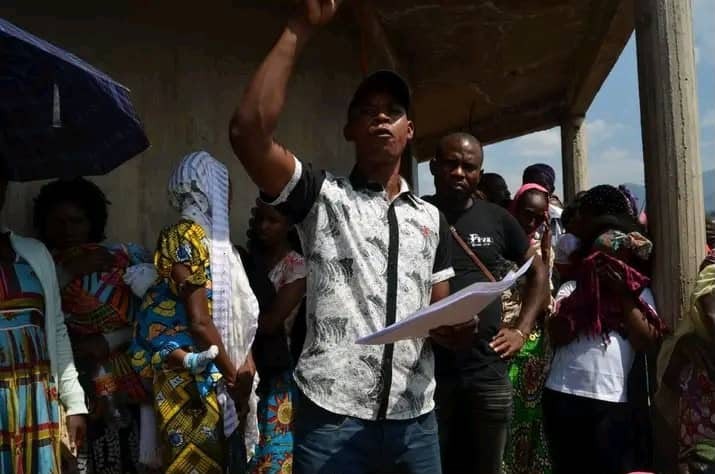
One of the striking features observed during Friday’s gathering was the manner in which Nchofon Mingoh managed the large crowd that had converged on the centre.
With more than 1,000 people reportedly seeking assistance, the sheer number placed considerable pressure on the facility and its personnel. Yet, Mingoh remained composed and confident as he engaged with those who had come seeking government support.
Rather than allowing the size of the crowd to overwhelm the process, he maintained what observers described as a professional and consistent approach in managing the people and explaining the situation to them.
His engagement with the IDPs appeared to help calm tensions and maintain order as the crowd waited for information on the assistance available.
For many of those who had arrived hoping to receive assistance, the outcome was not necessarily determined by whether they received an item that day, but also by how their concerns were handled.
Indeed, several people reportedly left the centre satisfied after receiving explanations about the situation.
“I am still very satisfied”
One IDP who was present at the centre captured the mood after the day’s proceedings.
Although the individual did not receive assistance on Friday, the person said the manner in which the coordinator addressed the crowd was reassuring.
“Though we were not given any assistance today, I am still very satisfied at how the coordinator explained things to us.”
The comment offers an insight into the importance of communication in the management of humanitarian assistance, particularly when large numbers of vulnerable people converge on a distribution centre with expectations of receiving immediate support.
For a population already grappling with displacement and uncertainty, clear explanations can sometimes help prevent frustration from turning into disorder.
A centre under pressure
Friday’s gathering nevertheless illustrates the continuing pressure on humanitarian assistance structures in Bamenda.
The sight of more than 1,000 people turning up at the centre in the early hours of the morning suggests that the demand for relief remains high despite the interventions carried out over the years.
For families who have lost homes, livelihoods or sources of income because of the crisis, basic items such as food, bedding, soap and other hygiene products remain important.
The crowd that gathered at the centre therefore tells a story beyond the distribution of relief materials. It reflects the continuing vulnerability of thousands of people caught up in a crisis that has persisted for years.
250,000 assisted, but needs persist
The government can point to the more than 250,000 beneficiaries who have received assistance through the centre as evidence of its humanitarian intervention.
Yet the latest development equally demonstrates that the humanitarian challenge has not disappeared.
The continuing arrival of vulnerable people at government assistance points raises the question of whether existing interventions are sufficient to meet the needs of the affected population.
For some residents, government humanitarian assistance remains a vital lifeline.
The September 11 gathering consequently presents a difficult paradox: a government centre that has reportedly assisted more than a quarter of a million people is still confronted by crowds of residents demanding help.
At the same time, Friday’s events demonstrated that the management of a humanitarian centre is not only about the distribution of material assistance. It is also about organisation, communication, patience and the ability to manage vulnerable populations under pressure.
For those who gathered at the Bamenda centre, the day’s experience appeared to reinforce that point. Even where assistance was not immediately available, some left acknowledging the effort made to explain the situation to them.
And in a crisis where frustration and uncertainty are never far from the surface, that communication can be as important as the assistance itself.