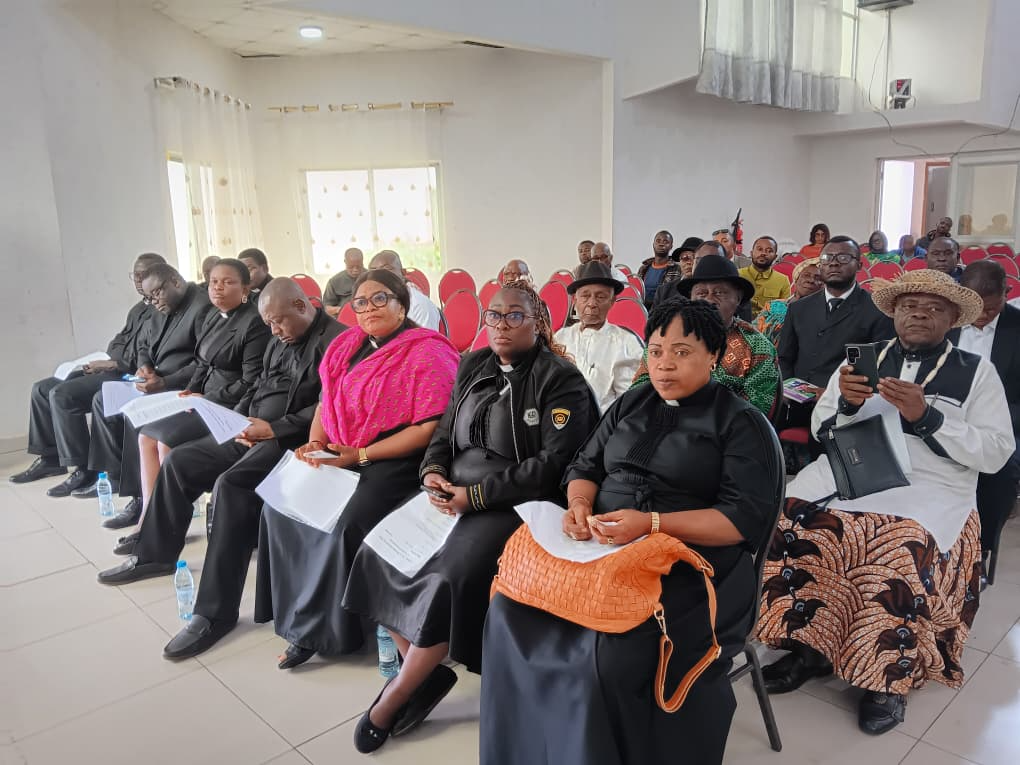
Clergy members in attendance
By Guy-Bruno Maimo
The Cameroon Association for Bible Translation and Literacy (CABTAL) has unveiled its 2025 Annual Report, showcasing significant strides in Bible translation, functional literacy, language development and community transformation as it continues expanding its impact across Cameroon.
The report was presented on Friday, July 3, 2026, at Mountain Hotel, where church leaders, partners, staff and other stakeholders reviewed the organisation’s achievements over the past year and its strategic direction for 2026.
Presenting the report, CABTAL’s General Director, Dr. Keyeh Emmanuel Lufang, described 2025 as a year of remarkable progress, citing major achievements in literacy, Bible translation, local Bible printing and institutional development.
“The achievement of 18,319 learners in different literacy classes, the printing of five different Bibles in five different languages through our own printing press here in Cameroon, and the dedication of the CABTAL Missionary Complex are some of the major highlights that we present in our annual report,” Dr. Lufang said.
According to the report, CABTAL enrolled 18,319 learners in 512 functional literacy classes across the country, with 4,007 learners successfully completing the programme and acquiring the ability to read and write in their mother tongues. The organisation also strengthened its partnership network by working with 1,329 partner congregations and assemblies, reinforcing church participation in literacy, Bible translation and Scripture engagement programmes.
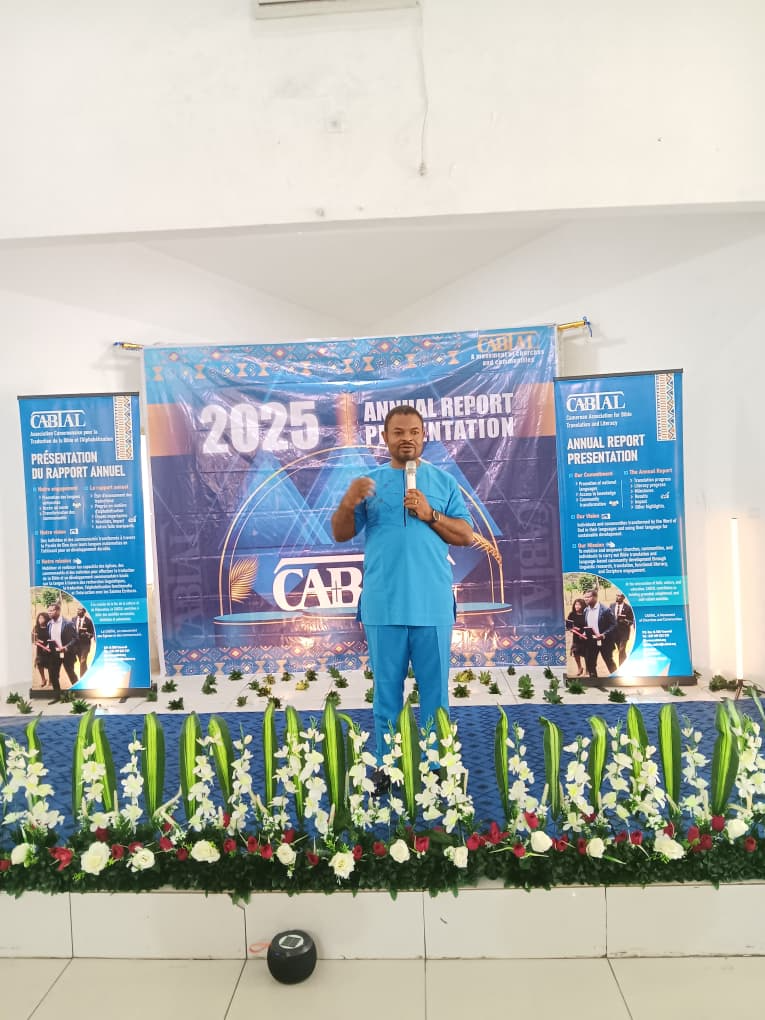
General Director presenting the CABTAL annual report
The literacy programme was implemented through CABTAL’s three operational zones—the Greater West, Greater North and Greater South—bringing mother-tongue education to diverse language communities throughout Cameroon.
Bible translation also recorded significant milestones in 2025 with the dedication of five New Testaments for the Moghamo, Bakweri, Nulibie, Esu and Weh language communities. The achievement brings CABTAL’s cumulative record to 39 dedicated New Testaments, while translation work is currently underway in 119 language communities through 60 active projects.
Another landmark achievement was the production of five Bibles through CABTAL’s own printing press in Cameroon, a development expected to improve access to translated Scriptures while reducing production delays and dependence on external printing services.
Explaining the importance of translating the Bible into indigenous languages, Dr. Lufang said the work goes beyond language preservation to ensuring that communities encounter God’s Word in the language they understand best. “When you communicate to somebody in a foreign language, it goes to their head, but when you communicate to somebody in their mother tongue, it goes directly to their heart,” he said, quoting Nelson Mandela. “There are some people who will never have the opportunity to learn English or French. When they have the Bible in their own language, it includes them in God’s plan of redemption and transformation. We invest a lot of time to translate the Bible in the mother tongue because there are some people who can only be reached with the Word of God in a language that speaks best to their hearts.”
Beyond translation and literacy, CABTAL continued investing in Scripture engagement activities, including workshops on trauma healing, gospel and culture, and Bible storytelling. Although financial constraints limited implementation to 48 of the 60 planned workshops, the organisation said the programmes continued to strengthen the practical use of Scripture within communities.
The report also highlighted CABTAL’s growing investment in technology. Artificial intelligence tools such as Scripture Forge are now supporting Bible translation by helping translators prepare initial drafts that are later refined through detailed linguistic and theological review. In addition, 175 translators received training in linguistics, orthography development and discourse analysis, while selected staff underwent advanced Hebrew and Greek studies to further improve translation quality. CABTAL also strengthened its institutional capacity with the dedication of the CABTAL Missionary Complex, a 16-apartment facility designed to host staff, partners and conferences, further supporting the organisation’s growing national and international collaborations.
Looking ahead, the organisation plans to begin translation work in seven additional language communities and dedicate five more Bibles in 2026. It also intends to deepen engagement with communities that already have translated Scriptures to encourage greater use of the Bible in everyday life.
Preparations are also underway for CABTAL’s 40th anniversary in 2027, which will celebrate God’s faithfulness over four decades, honour pioneers and past leaders, renew commitment to the organisation’s mission, and inspire a new generation to advance Bible translation and language development.
As CABTAL continues to expand its reach, the organisation says it remains committed to making God’s Word available in the heart language of every community while promoting literacy, preserving indigenous languages and contributing to sustainable community development across Cameroon.