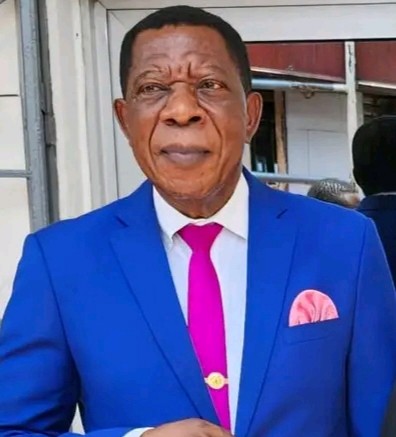
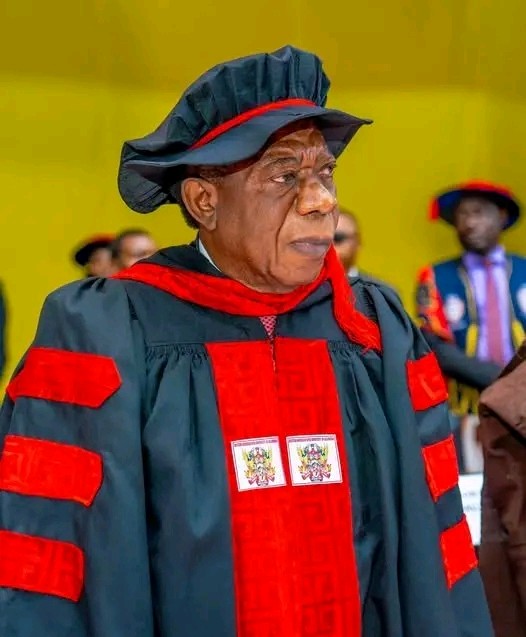
Sir, Dr Ntumfor Nico Halle
By Nformi Ngi Jones Tamfu
As Cameroon prepares to mark its 54th National Day on May 20, 2026 under the theme “National Unity: Backbone of Our Defence System, Bedrock of Cameroon’s Development”, a prominent voice of conscience has issued a sobering assessment of the state of the nation. Speaking on the national broadcaster’s flagship English-language radio programme, “Cameroon Calling”, celebrated peace advocate and legal luminary Sir Dr. Barr. Ntumfor Nico Halle expressed grave apprehensions about the country’s current socio-political climate, warning that structural injustice, rampant corruption, and ongoing violence threaten the very bedrock of Cameroonian unity.
While acknowledging that this year’s National Day theme focusing on national unity as the backbone of Cameroon’s defense system is “well-carved and well-thought-of,” Dr. Halle argued that the reality on the ground sharply contradicts the official rhetoric.
“I must confess that I am not very comfortable,” Dr. Halle stated candidly. “There is a lot of disillusion, despair, and disappointment across the territory.”
Invoking the famous ethos of the 35th US President, John F. Kennedy, Dr. Halle challenged his compatriots to pivot away from self-interest.
“JFK once said, “Ask not what your country can do for you, but rather ask what you can do for your country.” If we truly asked ourselves that, Cameroonians would not be engaged in such absurd behaviors. We would not see this desperate quest for money and the destruction of others to attain power,” he said.
The legal expert took aim at what he described as the systematic plundering of public resources, noting that anti-corruption bodies remain functionally helpless while embezzlement continues to “gallop and escalate.” This economic mismanagement, he stressed, directly drives the country’s crushing unemployment and poverty rates.
However, Dr. Halle argued that the crisis is not fundamentally a failure of statutory legislation, but a failure of the human heart.
“The rule of law has not failed because the laws are there; it is because the laws are not being respected. This is why I have introduced a new concept: “The Rule of Love”. The rule of love is what is missing in our country, in our system, in Africa, and across the whole world even in our churches. Unless we stop corruption, we can sing about love and harmony one million times, but nothing will change.”
A significant portion of Dr. Halle’s critique centered on systemic inequality, favoritism, and tribal discrimination. He likened a discriminatory government to a dysfunctional family.
“How can we have peace when certain offices or posts are reserved for specific privileged people? Is that justice? When you have ten children and you discriminate against two, you have pushed a dagger into your own family,” he warned.
Addressing the rise of hate speech, xenophobia, and the usage of derogatory tribal slurs, Dr. Halle reminded citizens that the Constitution guarantees every Cameroonian the right to live, purchase property, and build anywhere within the national territory.
Commenting on a recent controversial regional restriction, Dr. Halle slammed the local ban on the traditional North West delicacy, “Achu”, calling it “despicable.”
“How do you ban a traditional dish that people love? If we start down that road, other tribes will ban other dishes. This can ignite an unnecessary conflict, and we do not need that kind of division right now.”
Reflecting on his own life as a native of the Anglophone regions residing in Douala the economic capital, he praised his hosts: “I live in Douala and the Douala people are very nice, welcoming, and respectful. I have no problems with them. But just because I live peacefully does not mean all is well across the country. Something concrete must be done to make our ‘being together’ (“vivre-ensemble”) genuine.”
Turning his attention to his home regions of the North West and South West, Dr. Halle offered a scathing review of how the decade-long conflict has been managed by political authorities.
“Whether we like it or not, we did not handle the crisis well at the beginning. Wrong methods were used, which is why, up to this very moment, we have not gone far in resolving it. It has now morphed into a full-blown conflict. Some are using it to make money; others are using it politically.”
Expressing deep grief over the ongoing casualties on both sides of the military-separatist divide, he called for an honest appraisal of the war’s root causes.
“Do you know how I feel to know that soldiers are dying, our brothers and sisters are dying, civilians are dying, and properties are being destroyed for ransom? These things are mind-blowing and deeply painful. My heart bleeds. A celebration cannot be harmoniously organized when people are still holding guns.”
As a public figure who has served on the National Elections Observatory (ONEL), the National Commission for the Promotion of Bilingualism and Multiculturalism (NCPBM), and as the former President of the Presbyterian Christian Men Fellowship (CMF), Dr. Halle called for a national culture of “autocritique” (self-evaluation).
“We must evaluate ourselves, find our lapses, and correct them, or we will go nowhere,” he insisted. He called on both corporate governors and the governed to step up, noting that a breakdown in duties on both sides has left the country vulnerable to social collapse. He also reminded the nation of the lessons brought by the Pope during his historic visit to Cameroon, where the pontiff openly condemned tribalism, corruption, and the exploitation of the masses by a select few.
Despite his heavy critique, the veteran advocate concluded his address on a note of resilient hope.
“Diversity in Cameroon is a plus and a blessing that we should exploit positively, though it has often been manipulated to set us asunder. Yet, I am still very optimistic. We have good Cameroonians who can turn things around for the benefit of all.”