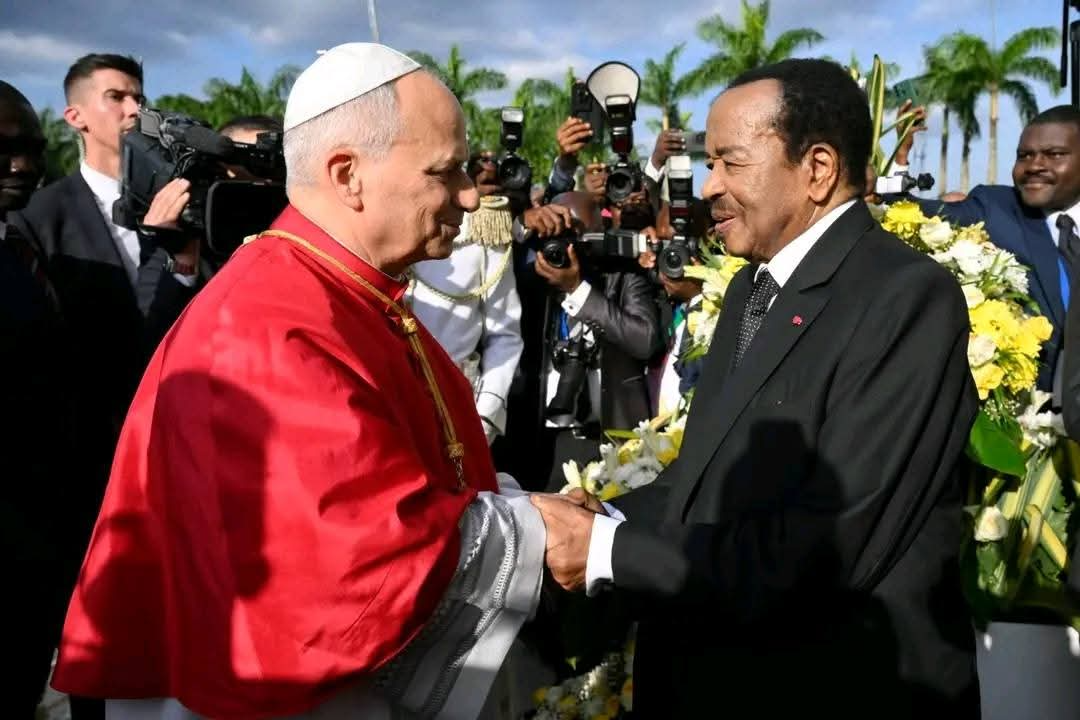
Pope Leo XIV and President Paul Biya in hand-shake at Unity Palace during reception
By Brian Mboh
Pope Leo XIV has left Cameroon after a four-day Apostolic sojourn where his message of peace, unity, justice, coexistence and breaking the chain of corruption reigning in Cameroon were re-echoed in Bamenda, Douala and Yaounde. This message, some analysts say was in line with what the Head of State of Cameroon, Paul Biya has always highlighted at every given opportunity that his has to address the nation.
The first pope from the US arrived in Cameroon delivered remarks railing against the whims of the rich and powerful and called for peace in a country roiled by sectarian conflict.
Speaking in French in front of officials and diplomats in the capital Yaounde, the pontiff called on Cameroon’s authorities for an examination of conscience and to break the chains of corruption.
Pope calls for Transparency in governance
Pope Leo XIV highlighted the need for transparency in the management of the country’s resources, that the rule of the law is vital in nation building.
Transparency in the management of public resources and respect for the rule of law are essential to restoring trust. It is time to examine our conscience and take a bold leap forward, he said.
He says within earshot of the country’s president, Pope Leo XIV urged “respect for human rights”.
Calls on respect of human right in maintaining security
Security is a priority, but it must always be exercised with respect for human rights, he said.
The Supreme Pontiff said, like many other nations, Cameroon is going through difficult times. The tensions and violence that have struck certain regions of the North West, South West, and Far North have caused profound suffering: lives lost, families displaced, children deprived of schooling, young people who see no future.
Behind the statistics are faces, stories, and shattered hopes. Faced with such dramatic situations, I call on humanity at the beginning of this year to reject the logic of violence and war, and to embrace a peace founded on love and justice, Pope Leo XIV said.
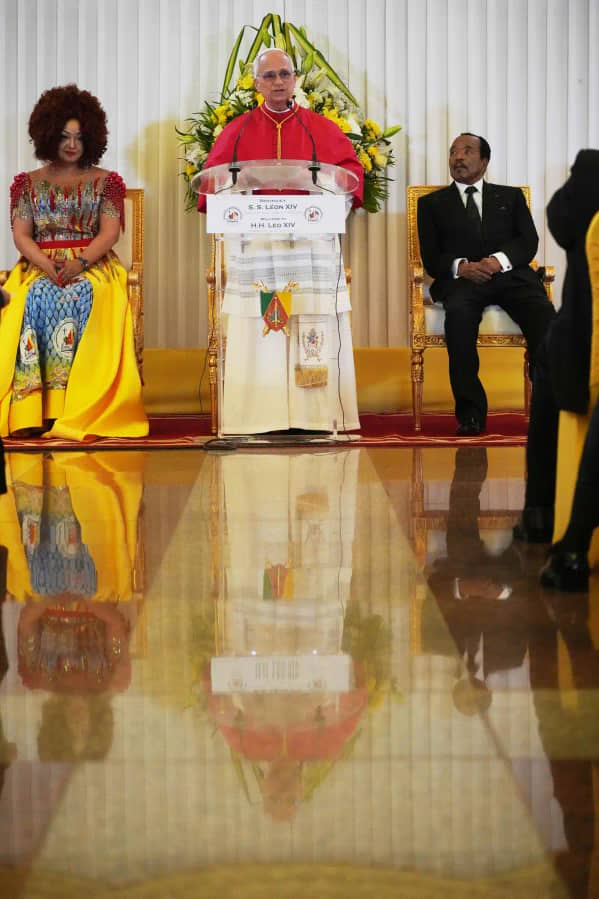
Pope Leo XIV speaking at Cameroon’s Unity Palace
Drums need for disarmed peace
The Vicar of Christ says, there is the need for a disarmed peace, that is, one not based on fear, threats, or armaments; and disarming, because it is capable of resolving conflicts, opening hearts, and fostering trust, empathy, and hope.
He furthers that, peace cannot be reduced to a slogan: it must be embodied in a personal and institutional approach that rejects all forms of violence. That is why he repeat it forcefully:
“The world thirsts for peace. Enough of wars, with their painful trail of death, destruction, and exile.”
According to the Pontiff, this cry is intended as a call to action for the will to contribute to genuine peace, placing it above all partisan interests. Peace, in fact, cannot be decreed: it is embraced and lived. It is a gift from God that develops through patient and collective work. It is everyone’s responsibility, first and foremost that of civil authorities.
Credible institutions that guarantee progress, love not disunity
He said to govern is to love one’s country, but also neighboring countries. The commandment “love your neighbor as yourself” also applies to international relations! To govern is to truly listen to citizens, to value their intelligence and their capacity to contribute to developing lasting solutions to problems. Pope Francis stressed the need to move beyond “this conception of social policies as a policy toward the poor, but never with the poor, never for the poor, and even less as part of a project that unites peoples.
Role of civil society and youth
Pope Leo XIV paid tribute to civil society organisations, including women’s groups, youth movements, and religious leaders, describing them as essential to national cohesion and conflict resolution.
He gave particular recognition to women, calling them “tireless builders of peace” whose voices must be more fully included in leadership.
Young people, he said, represent Cameroon’s greatest hope. He urged investment in education and employment opportunities to prevent social instability and the loss of talent.
Religious cooperation and legacy
The visit also underscored the Vatican’s ongoing relationship with Cameroon. The Pope recalled previous papal visits, including those of Pope John Paul II and Pope Benedict XVI, which he said had left a lasting imprint on the country’s moral and political life.
He reaffirmed the Catholic Church’s commitment to supporting education, healthcare, and social services in Cameroon while promoting interfaith dialogue.