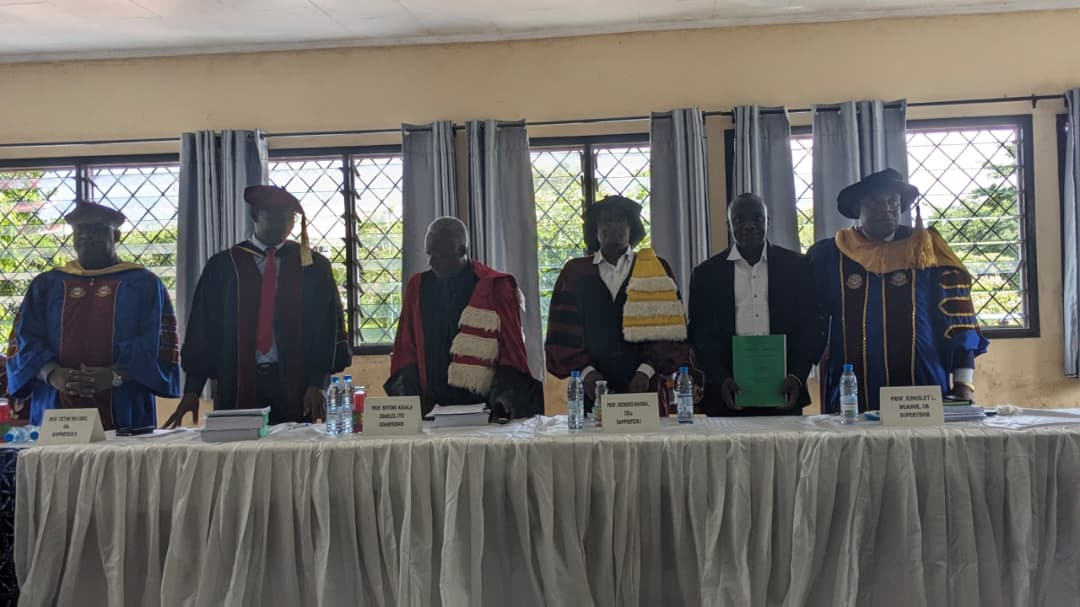
Dr Neville Ndiwang (second person from right) with his PhD defense panel
By Guy-Bruno Maimo
A new doctoral study has found that patterns of negative news reporting in Cameroon may be contributing to growing voter apathy, raising calls for more balanced and responsible journalism to strengthen democratic participation.
The findings were presented during the PhD defense of Dr Mesumbe Neville Ndiwang, whose thesis titled “The Influence of Bad News Reports on Voter Apathy in Cameroon” was defended on Saturday, April 18, 2026, at the Faculty of Social and Management Sciences, FSMS, boardroom of the University of Buea.
Speaking after the defense, Dr Ndiwang described the journey as long and demanding, explaining that it stretched over five years and was marked by several academic and personal challenges. He noted, however, that persistence and institutional support helped him successfully complete the process, encouraging other doctoral candidates to remain committed despite difficulties.
The study was supervised by Professor Kingsley Ngange Lyonga, Professor of Journalism and Communication Sciences, who described the work as a significant contribution to understanding the relationship between media narratives and political participation in Cameroon.
He explained that the research examined how sustained exposure to negative political news can influence citizens’ perceptions of elections and governance, gradually discouraging electoral participation. According to him, the study combined agenda-setting and framing theories to explain how media narratives shape public opinion, while also drawing on critical realism and social constructivism within a mixed-methods framework.
Professor Lyonga further noted that the findings confirm a link between dominant negative news framing and voter disengagement, but stressed that journalism must remain balanced rather than avoid critical reporting altogether. “The solution is balance in reporting, not the elimination of bad news,” he said.
The defense panel was chaired by Professor Boyomo Assala Charles, with members including Professors George Madiba, Victor Ngu Cheo, Kingsley Ngange, and Julius Che Tita, who evaluated the academic quality and contribution of the thesis.
The study concludes that while negative news is an essential part of journalism, its dominance in media spaces can shape political attitudes and reduce civic engagement. It recommends more balanced reporting practices as a way of encouraging voter participation and strengthening democratic culture in Cameroon.