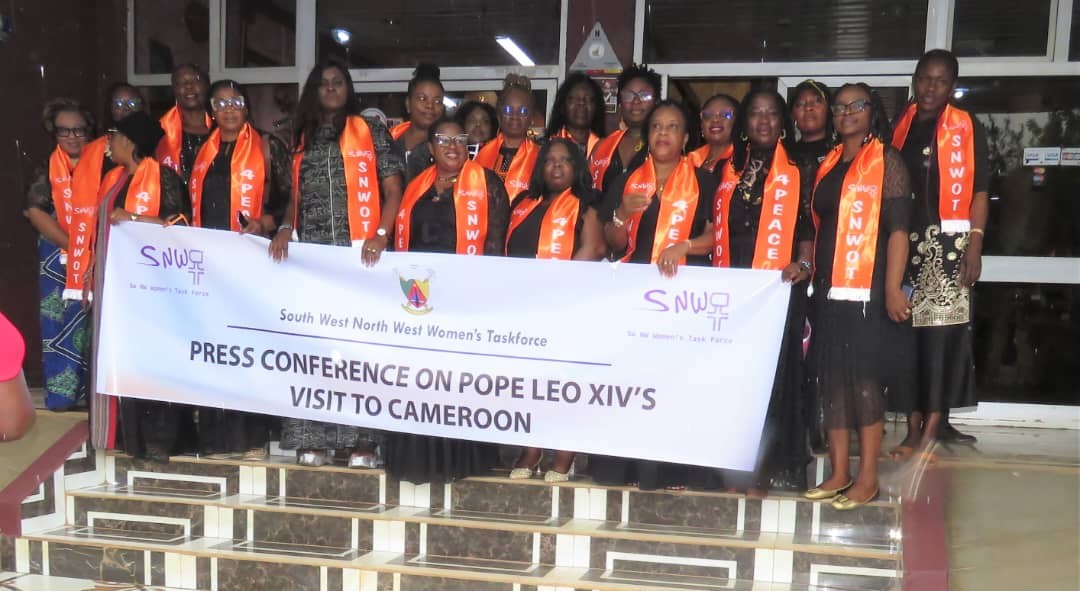
SNWOT members pose for a group picture at the end of the event
By Neba Jerome Ambe
The South West North West Women’s Task Force (SNWOT) has voiced strong concern over its absence from the list of groups scheduled to meet Pope Leo XIV during his visit to Bamenda, describing the omission as a troubling signal for women’s participation in peace efforts.
Addressing the press in Bamenda on Wednesday, April 15, 2026, leaders of the task force said the exclusion reflects a persistent pattern in which women, despite their frontline role in peacebuilding are sidelined in high-level engagements tied to resolving the Anglophone crisis.
Speaking for the group, Eileen Akwo, North West Regional Coordinator of SNWOT recalled that at the onset of the crisis, women’s voices were largely absent from national and international discourse until SNWOT stepped forward to raise alarm. “At a time when attention was limited, we amplified the realities on the ground and helped bring global focus to the situation in the North West and South West,” she said.
That early advocacy, she noted, eventually opened the door for the group’s participation in the Major National Dialogue, although not without resistance. SNWOT members had to lobby for inclusion in key commissions after initially being overlooked.
National Coordinator Clotilda Andiensa Waah said the task force went on to make substantive contributions, particularly in discussions on Disarmament, Demobilisation and Reintegration (DDR), while also strengthening collaboration with other women-led platforms, including the National Women’s Peace Movement.
Over time, SNWOT has evolved from a pressure group into a structured network engaging communities, civil society actors, and, at times, non-state armed groups. During the peak of school boycotts, members held consultations with separatist-linked actors abroad, contributing to a shift in rhetoric around access to education, according to the group.
At the Bamenda press briefing, held at Ayaba Hotel, SNWOT reaffirmed its commitment to nonviolence and inclusive dialogue, emphasizing that sustainable peace cannot be achieved without the full participation of women. “The Pope’s visit should not be reduced to symbolism,” one executive member said. “It should mark a turning point toward concrete action, grounded in listening to all voices, especially those directly affected by the crisis, including internally displaced persons and marginalised communities.”
While acknowledging the moral influence of the pontiff and the Catholic Church in Cameroon, the group expressed hope that his presence would inspire meaningful engagement across divides. They also pointed to what they described as early signs of goodwill linked to the visit, including a temporary ceasefire reportedly declared by some armed groups and the anticipated return of individuals who had stayed away from Bamenda for years.
SNWOT maintains that a durable resolution to the decade-long conflict requires direct and genuine dialogue between the government and separatist leaders. “There must be clarity on who the actors are, their influence on the ground, and a sincere commitment to negotiations,” the group stated.
Despite its exclusion from the Papal audience, the task force insists it remains ready to contribute to peacebuilding efforts at all levels. Its message, members stressed, is consistent: no lasting solution can emerge without women being fully included in decision-making processes.